




In recent decades, many views and theories about intelligence have emerged, and Gardner’s theory of intelligence is one of these views. Intelligence is an ability that involves all human cognitive processes. This potential ability is for all humans and does not belong to a specific group. Every baby is born with a set of potential abilities that can be measured.
Howard Gardner, who has 31 honorary doctorates from the most prestigious universities around the world, was born in 1943 in America. He was a psychologist and professor at Harvard University. The most important factor of this psychologist’s fame was his theory of multiple intelligence. In 1983, Gardner published the mentioned theory in his book “Mental Frameworks, Theory of Multiple Intelligences”. This theory, which became known as Gardner’s theory of intelligence, originally had 8 components. In other words, at the time of the publication of this theory, Gardner stated that humans have 8 types of intelligence. But after a few years, he added another component (existential or existential intelligence, moral intelligence) to the 8 mentioned intelligences.
According to critics, Gardner’s theory of intelligence includes something beyond human intelligence. They believe that the 8 components expressed in Gardner’s theory include talents, personality traits and human abilities. Before the publication of Gardner’s theory of intelligence, people considered intelligence to be only mathematical intelligence (IQ). They measure the level of ability and the level of intelligence of people with the IQ coefficient. But according to Gardner, humans need abilities beyond mathematical intelligence to solve social problems, produce new products or provide valuable services.
What is Gardner’s definition of intelligence?

From Gardner’s point of view, intelligence is the ability and potential of the biological psychological type to process and analyze information. These abilities are activated in different conditions and different cultural arrangements and help people to find solutions for the problems ahead or to produce and present a product in which the culture is valuable and respected.
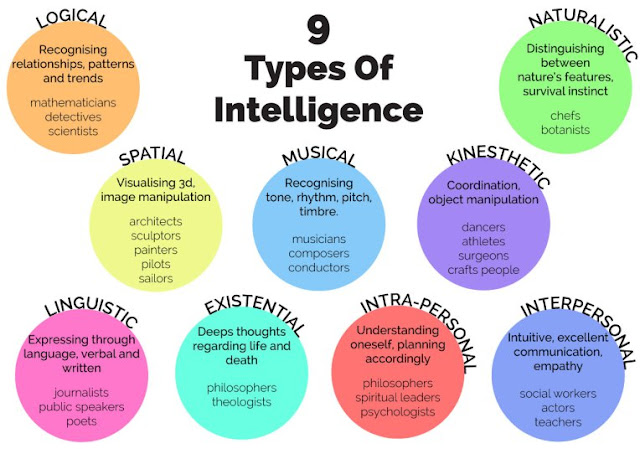
According to Gardner’s intelligence theory, in order to know a person’s abilities, one should not only pay attention to his IQ, but also other types of intelligence, including musical intelligence, intrapersonal and extrapersonal intelligence, logical-mathematical intelligence, visual-spatial intelligence, and physical intelligence. – movement, verbal-linguistic intelligence and nature-oriented intelligence were also taken into account.
How many components does Gardner’s intelligence theory include?
Verbal-linguistic intelligence
2. Image-spatial intelligence
3. Kinetic intelligence
4. Social intelligence or extroversion
5. Intrapersonal intelligence
6. Musical intelligence
7. Logical-mathematical intelligence
8. Natural intelligence
9. Existential or ontological intelligence
Gardner’s theory of intelligence states that humans have several types of intelligence. Each type of intelligence also has a variable coefficient from low to high. As a result, the intelligence level of different people is different from each other.
Gardner’s definition of 9 intelligences:
1. Verbal-linguistic intelligence
According to Gardner’s theory of intelligence, verbal intelligence is defined as: “a person’s mastery of words and the ability to use them correctly based on the main components of intelligence theory”. Now, the main components of semantics, phonetics, knowledge of language rules and grammar, and knowledge of the use of language and words in different situations are meant.
Verbal intelligence is the basis of the art of expression. You have definitely seen people who have a very strong expression technique, these people had the field of verbal intelligence and strengthened it through practice and repetition. People with high verbal intelligence, in addition to mastering the art of expression, are also skilled in listening well, understanding meanings, recalling information, and persuading others. People with high verbal intelligence will be successful in jobs such as poetry, writing, teaching, lawyering, translation and political positions.
– Characteristics of verbal-linguistic intelligence:
- Ability to recall written or spoken information
- Enjoy reading and writing
- Skill in debate or persuasive speech
- Ability to explain issues
- Use humor when telling stories
2. Image-spatial intelligence
In Gardner’s theory of intelligence, visual-spatial intelligence is the ability to mentally visualize without the main stimulus, understand visual and spatial information, and transform them. The extent of our ability to visualize our surroundings depends on this component.
Visual intelligence can be defined as the ability to interpret images and patterns and recreate them in three dimensions. People with high visual intelligence acquire information with the help of creating a clear image in their mind. These people are very fond of using charts, maps and pictures.
It is undeniable that the visual intelligence expressed in Gardner’s theory of intelligence exists in all people. But without a doubt, some people are more capable than others in this field. The skills of this group of people include making puzzles, understanding diagrams and shapes, good orientation, drawing and painting, visual arts, etc. Seafaring, sculpture, inventor, explorer, architect, interior designer, mechanic and engineer are also suitable jobs for this group of people.
– Features of image-spatial intelligence:
- Enjoy reading and writing
- Skill in making puzzles
- Skill in interpreting photos, graphs and charts
- Enjoy drawing, painting and visual arts
- Easy pattern recognition

3. Kinetic intelligence
People with kinesthetic intelligence have the ability to use all or part of the body to solve problems, control coarse and fine movements, manipulate objects professionally. People with kinesthetic intelligence have a high skill in maintaining balance between their hands and eyes and other parts of their body. These people are also adept at interacting with the surrounding world to gather information.
Kinetic intelligence – movement in Gardner’s theory of intelligence allows us to express emotions through body movements. People who have a high kinetic intelligence usually use their physical mastery to do things. Because these people have great strength in physical movements, operations and physical control.
The presence of skills such as dance, sports movements, acting, expressing emotions through body language in these people makes them successful in jobs such as sports coach, fireman, craftsman, dancer, actress, etc.
– Characteristics of kinetic intelligence:
- Skill in sports and dance
- Enjoy making things with your hands
- Excellent physical coordination
- Remembering things by doing them, rather than listening or seeing

4. Extrapersonal or social intelligence
Social intelligence is considered one of the important components of Gardner’s intelligence, because it is through this intelligence that we can communicate with others and reach a correct understanding of their feelings, intentions and beliefs. With the help of social intelligence, you can use verbal and non-verbal skills and encourage others to participate in the community.
People with high social intelligence can easily imagine themselves in the position of others, empathize with people and understand them. These people are also skilled in resolving differences and inducing positive feelings to others.
Groups of people with social intelligence from Gardner’s series of intelligence components will make excellent politicians, salespeople, consultants, and businesspeople.
– Features of extrapersonal or social intelligence:
- Verbal communication skills
- Skill in non-verbal communication
- Looking at people from different angles
- Building positive relationships with others
- Skill in quelling differences within groups

5. Intrapersonal intelligence
In Gardner’s theory of intelligence, intrapersonal intelligence means the ability to understand and recognize oneself. Intrapersonal intelligence makes a person aware of his inner and personal states. People with this intelligence know their feelings, inner decisions, positive and negative points and have a correct understanding of them. Due to the fact that they have the power to manage their reasoning and thinking, these people can be philosophers, theorists, researchers, inventors, writers, scientists, idea developers, educators, psychologists, and theological experts.
– Features of intrapersonal intelligence:
- Skill in analyzing your strengths and weaknesses
- Enjoy analyzing theories and ideas
- A lot of self-awareness
- Having a clear understanding of the root of your motivations and emotions
6. Musical intelligence
Gardner’s theory of intelligence says: Musical intelligence is the ability to produce, understand and understand music and to construct and convey the meaning of a song. Of course, in addition to these abilities, a person should also know the use of various instruments, the quality and range of their sound. People with musical intelligence are sensitive to all issues related to music and react to them.
Musical intelligence increases a person’s attention to the sounds of the surrounding environment. According to Gardner’s theory of intelligence, musical intelligence allows a person to draw inspiration from surrounding sounds to create a work of art. These people will become successful musicians, singers, composers and designers of musical instruments.
These people will be skilled in playing any instrument because they enjoy music and are very precise and strong in thinking about rhythms and sounds.
Features of musical intelligence:
- Enjoy singing and playing musical instruments
- Easy recognition of music patterns and notes
- Ability to memorize songs and melodies
- Deep understanding of musical structure, rhythm and notes

7. Logical-mathematical intelligence
This component of Gardner’s intelligence refers to the ability to do mathematical calculations. People with mathematical intelligence are easily able to recognize and calculate mathematical problems. These people experiment for everything and ask a lot of questions about the issues around them. People with high logical-mathematical intelligence categorize information correctly, like thinking about natural phenomena, easily work with geometric shapes and perform mathematical calculations.
These people have great ability to analyze problems and improve illogical systems and seek to discover fundamental and true patterns in various subjects.
According to Gardner’s theory of intelligence, a person with a high mathematical IQ makes long and difficult arguments in order to be able to answer problems. Such a person can easily become a successful scientist, mathematician, accountant, engineer or programmer.
– Features of logical-mathematical intelligence:
- Great skill in solving problems and playing with numbers
- Enjoy thinking about abstract ideas
- Interested in conducting scientific experiments
- Ability to perform complex calculations

8. Natural intelligence
It is not impossible that a person does not fit in any of the components of Gardner’s intelligence. People who have a low IQ in all the cases mentioned so far, usually have naturalistic intelligence. These people are very interested in nature and everything related to nature. Botany, zoology, camping in nature, nature photography, mountain climbing and desert travel are among the interests of this group of people.
According to Gardner, those with high naturalistic intelligence are more attuned to nature and are usually interested in nurturing, exploring the environment, and learning about creatures. These people quickly become aware of the smallest changes in their environment.
And the popular interests of people with naturalistic intelligence also include things like agriculture, gardening, biology, environmental protection, painting and photography of nature and hiking.
– Features of naturalistic intelligence:
- Interested in subjects such as botany, biology and zoology
- Skill in categorizing and cataloging information
- Enjoy gardening, exploring nature, hiking and camping in nature
- Disinterest in learning subjects unrelated to nature

9. Existential or ontological intelligence:
Existential or ontological intelligence in Gardner’s theory of intelligence refers mostly to transcendental issues. Therefore, people who have a high coefficient of existential intelligence seek to understand existence and the philosophy of existence of complex issues such as God, the universe, and the origin of life. These people are constantly looking for a convincing answer to their questions.
A major part of the energy of this group of people is spent on the way to get to the nature and existence of complex issues. These people seem to be good philosophers, spiritualists, astrologers, meditation and mind control instructors.
– The characteristics of existential or ontological intelligence (ambiguous questions):
- who is god
- How was the universe created?
- What is the meaning of death?
- What will be the fate of man after death?

Gardner’s theory of intelligence has had supporters and opponents. Opponents of this theory say: it is very difficult to summarize and draw conclusions from this theory, because Gardner’s theory of multiple intelligences has been widely proposed. Another group of opponents believe that Gardner’s theory of intelligence does not have a solid research basis.
But on the other hand, as mentioned, Gardner’s theory of intelligence has attracted the attention of many scientific and social communities.


No comment